

Method Library | Method Description
FMEA
FAILURE MODE AND EFFECTS ANALYSIS
From reacting to failures to preventing them before they occur. FMEA is a systematic risk analysis method used to identify potential failure modes, understand their causes and effects, evaluate associated risks, and define preventive or detective actions.
It provides a structured basis for improving product reliability, process robustness, quality and safety throughout product and process development.
FMEA is particularly important within Advanced Product Quality Planning (APQP), where Design FMEA and Process FMEA support preventive quality planning before problems reach production or the customer.
Profile & Key Facts
Category
Preventive Quality & Risk Analysis Method
Difficulty | Complexity
High – Requires detailed technical knowledge, systematic analysis and effective cross-functional collaboration.
Investment | Resources
Medium to High – Mainly engineering and team resources; typically supported by structured FMEA software or standardized worksheets.
Recommended Group Size
4–8 participants, preferably cross-functional.
Typical participants include design, quality, manufacturing, testing, service and relevant supplier specialists.
Time Required
2 hours to several workshops, depending on system complexity and scope.
Areas of Application
Product development, process development, manufacturing planning, risk management, APQP, design reviews, change management and continuous improvement.
Industry Application
Widely applicable across engineering industries, with particularly strong use in automotive, aerospace, manufacturing and safety-related systems.
Your APQP source explicitly emphasizes that PFMEA should be completed by a cross-functional team and should follow the process flow analysis
History
Origin
FMEA originated in the late 1940s, with procedures developed by the U.S. Armed Forces following the Second World War.
NASA subsequently adopted FMEA during the early 1960s, and variants of the method were applied in programs including Apollo, Viking, Voyager, Galileo, Magellan and Skylab.
Synonyms
Failure Mode and Effects Analysis
Potential Failure Mode and Effects Analysis
Design FMEA (DFMEA)
Process FMEA (PFMEA)
Fun Fact
FMEA became an important automotive quality-planning method and today forms part of the interconnected quality methods used within APQP together with tools such as PPAP, MSA and Control Plans.
Objectives and Basic Concept
The central idea of FMEA is simple:
Do not wait for a failure to happen before understanding its consequences.
The method systematically examines how a product, system or process could fail and determines what should be done to prevent the failure or reduce its impact.
The analysis connects:
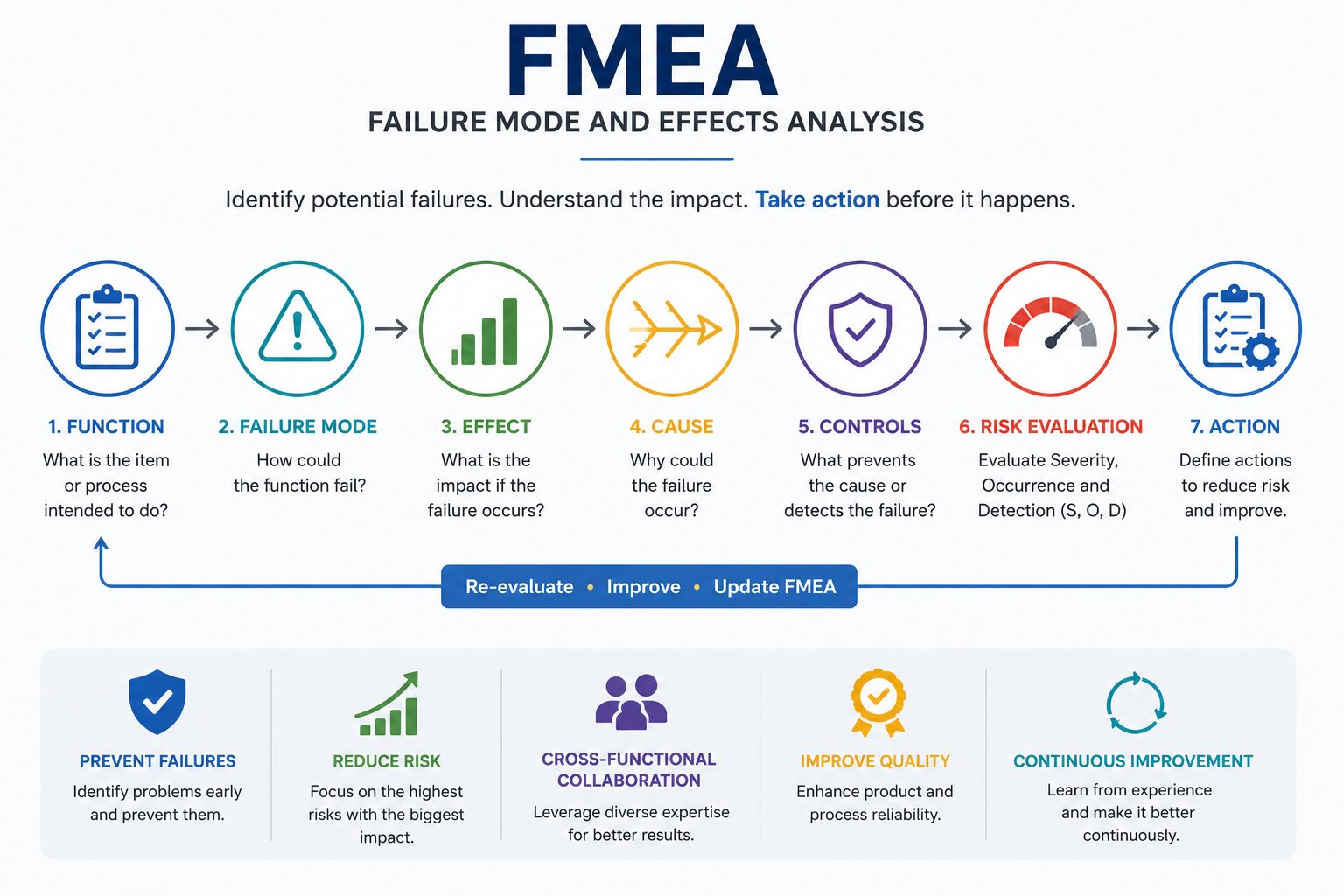
Functions → Failure Modes → Effects → Causes → Controls → Risks → Actions
This creates transparency regarding technical risks and allows engineering resources to be focused on the areas where preventive action provides the greatest value.
FMEA therefore supports the fundamental principle of preventive quality planning: identify and manage risk before the failure reaches production or the customer. Your automotive APQP source describes this directly as taking a proactive approach to what can go wrong and managing the associated risks.
Method in Detail
FMEA follows an inductive, bottom-up approach: individual elements and their potential failures are investigated to determine their effects on the higher-level system.
Function
What is the product, component or process step expected to do?
A clear understanding of intended function provides the basis for identifying meaningful failures.
Failure Mode
How could the function fail?
Examples include:
- No function
- Partial function
- Incorrect function
- Intermittent function
- Unintended function
Failure Effect
What happens if the failure occurs?
Effects should be considered from the perspective of subsequent processes, the customer, the end user and, where relevant, safety or regulatory requirements.
Failure Cause
Why could the failure occur?
Causes describe the mechanisms or conditions that could create the failure mode.
Prevention Controls
What currently prevents the cause from occurring?
These can include design principles, process controls, specifications, simulations or established engineering practices.
Detection Controls
How would the failure or cause be detected before reaching the customer?
Examples include testing, inspection, monitoring and verification activities.
Risk Evaluation
The identified risks are evaluated using the applicable FMEA methodology so that critical topics can be distinguished from lower-priority risks.
Optimization
Actions are defined to:
- prevent the cause,
- reduce the probability of occurrence,
- improve detection,
- or reduce the consequences through design changes where possible.
After implementation, the risk is reassessed.
Application
1. Define Scope and Planning
Define the product, system, subsystem or process to be analyzed and establish the cross-functional FMEA team.
2. Perform Structure Analysis
Break the analysis object into its relevant system elements, components or process steps and understand their relationships.
3. Perform Function Analysis
Determine the intended functions and requirements of each relevant element.
4. Perform Failure Analysis
Identify potential failure modes, their effects and their underlying causes.
5. Perform Risk Analysis
Evaluate the identified failure chains using the applicable severity, occurrence and detection criteria.
6. Define Optimization Actions
Prioritize risks and define preventive or detection-oriented measures with clear responsibilities and deadlines.
7. Document Results and Reassess
Implement the measures, reassess the resulting risk and maintain the FMEA as the product or process evolves.
Tips
Treat FMEA as an engineering process, not a form-filling exercise.
The value of FMEA comes from the technical discussion behind the entries, not from completing the document itself.
Use a genuinely cross-functional team and involve specialists who understand the design, manufacturing process, testing, field behaviour and customer requirements.
Start FMEA early enough that identified risks can still influence the design or process.
Use actual engineering evidence, test results, lessons learned, warranty information, process data and previous failures, rather than relying only on assumptions.
Finally, update the FMEA after design changes, process changes, new failures or significant new knowledge. It should remain a living risk document.
Pitfalls
Typical mistakes significantly reduce the effectiveness of an FMEA:
- Performing the FMEA only to fulfil a customer or audit requirement.
- Starting the analysis after major design or tooling decisions are already fixed.
- Using vague failure modes such as „bad quality“ instead of technically precise descriptions.
- Confusing failure modes, effects and causes.
- Allowing one person to complete the entire FMEA without cross-functional input.
- Focusing excessively on numerical ratings rather than understanding the actual technical risk.
- Copying an old FMEA without validating whether its assumptions remain applicable.
- Defining actions without responsibilities, deadlines or subsequent verification.
- Failing to update the FMEA when the product or process changes.
Strengths and Limitations
When does the method provide particular value?
+ Preventive risk identification
Potential problems can be addressed before they become field or production failures.
+ Structured engineering knowledge
Functions, failures, causes, controls and actions are documented systematically.
+ Cross-functional understanding
Different engineering disciplines evaluate risks together rather than in isolation.
+ Supports APQP
FMEA provides important risk information for downstream quality-planning activities. For PFMEA specifically, your MSA source states that its outcome is transferred to the Control Plan.
What are the limitations of the method?
~ Quality depends on team knowledge
Unknown failure mechanisms cannot automatically be discovered simply by completing an FMEA.
~ Resource intensive
Complex products can create very large analyses requiring substantial engineering effort.
~ Individual-failure orientation
Traditional FMEA primarily investigates individual faults. Complex combinations of faults may require complementary techniques such as FTA.
~ Requires continuous maintenance
An outdated FMEA can create false confidence instead of useful risk transparency.
Result
At the end of the FMEA process, a structured risk analysis is available containing:
Functions → Potential Failures → Effects → Causes → Existing Controls → Risk Evaluation → Improvement Actions → Responsibilities
The result provides a documented basis for preventive engineering decisions and supports subsequent activities such as Control Plan development, validation planning, design optimization and process improvement.
For PFMEA, the documented risk analysis should directly support the Control Plan
Alternatives
Fault Tree Analysis (FTA)
Use FTA when the analysis should start with a defined undesirable system event and systematically determine combinations of causes that could create it.
FTA is top-down, whereas FMEA is predominantly bottom-up. The two approaches are complementary and can be combined.
HAZOP
Suitable when systematic deviations from intended operating conditions need to be examined, particularly in complex process or safety-related systems.
Risk Matrix
Useful for faster, higher-level risk assessment when the detailed functional and failure-chain structure of FMEA is unnecessary.
7SIGMA Context | Relevance in Our Professional Engineering Environment
FMEA is directly relevant to 7SIGMA’s work because it connects product development, process development, quality management and risk management.
Quality Management
FMEA provides a structured basis for identifying potential quality failures before they become customer complaints, scrap, rework or field failures.
Systems Engineering
DFMEA supports the systematic analysis of system and component functions, failure modes and technical consequences during development.
Manufacturing & Industrialization
PFMEA identifies risks associated with manufacturing and assembly processes and provides important input for subsequent process controls.
Risk Management
FMEA converts technical knowledge into a documented and traceable risk analysis, allowing preventive actions to be prioritized and monitored.
Normative Basis and Standards
For this section, I would be careful not to claim that every listed standard „defines FMEA“ in the same way.
AIAG & VDA FMEA
A central automotive reference methodology for systematic Design and Process FMEA.
SAE J1739
Provides guidance for Design FMEA and Process FMEA applications. It is explicitly referenced as an example FMEA standard in your ISO 26262 material.
IATF 16949
Automotive quality-management requirements create the broader framework in which preventive risk-analysis methods such as FMEA are extensively applied.
ISO 26262
For functional safety of road vehicles, FMEA is used as a safety-analysis technique. ISO 26262 describes FMEA as an inductive, bottom-up approach and discusses its complementary relationship with FTA.
AS9145
Within aerospace APQP, AS9145 establishes requirements for Advanced Product Quality Planning and Production Part Approval Process
Templates, Documents and Downloads
Access practical FMEA templates and supporting documents for structured risk analysis and documentation.
Moderation and Consulting
Need support with a complex FMEA?
7SIGMA supports organizations in FMEA preparation, moderation, risk evaluation, optimization and implementation within product and process development.
Workshops and Training
Build practical FMEA competence within your engineering and quality teams through application-oriented workshops and training.
From understanding failure chains to conducting structured DFMEA and PFMEA sessions, the focus is on applying FMEA effectively in real engineering environments.
Our References in This Area
